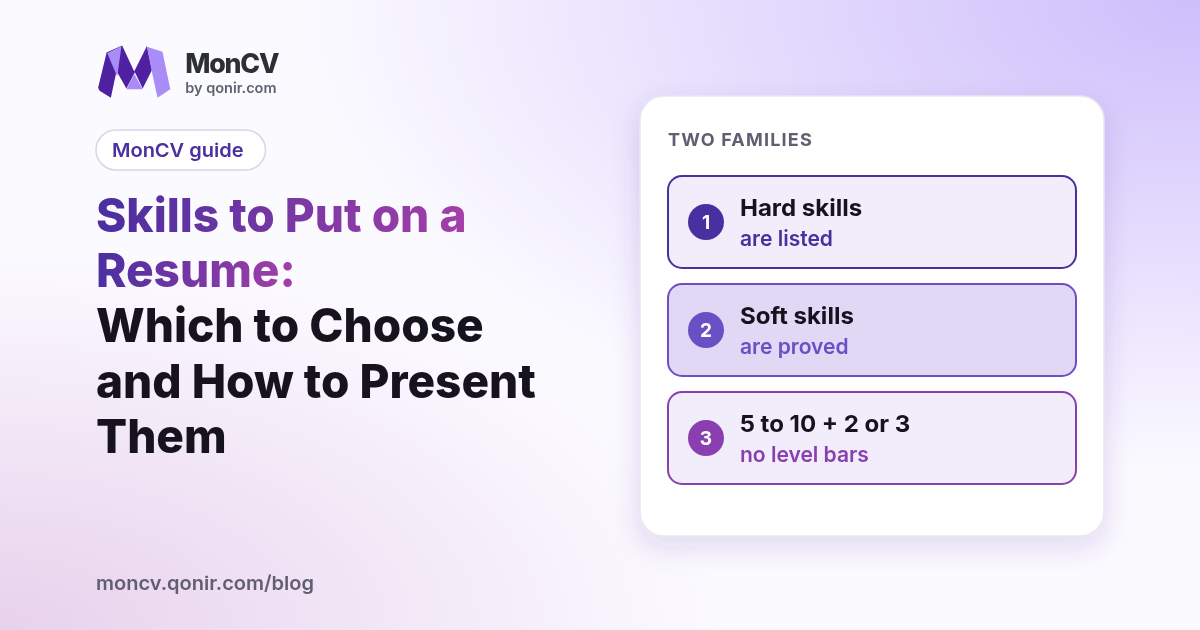
The "skills" section is often the quickest to fill and the least well read. People pile up words, "hardworking", "Word", "team player", "Excel", hoping one of them hits the mark. Yet it is one of the first places a recruiter looks to see whether you can do the job. This guide explains which skills to put on a resume, how to choose them from a job posting, how to present them and how to prove them, with a fictional before-and-after example.
Hard skills and soft skills: what are we talking about?
There are two families of skills, and mixing them without method blurs the reading.
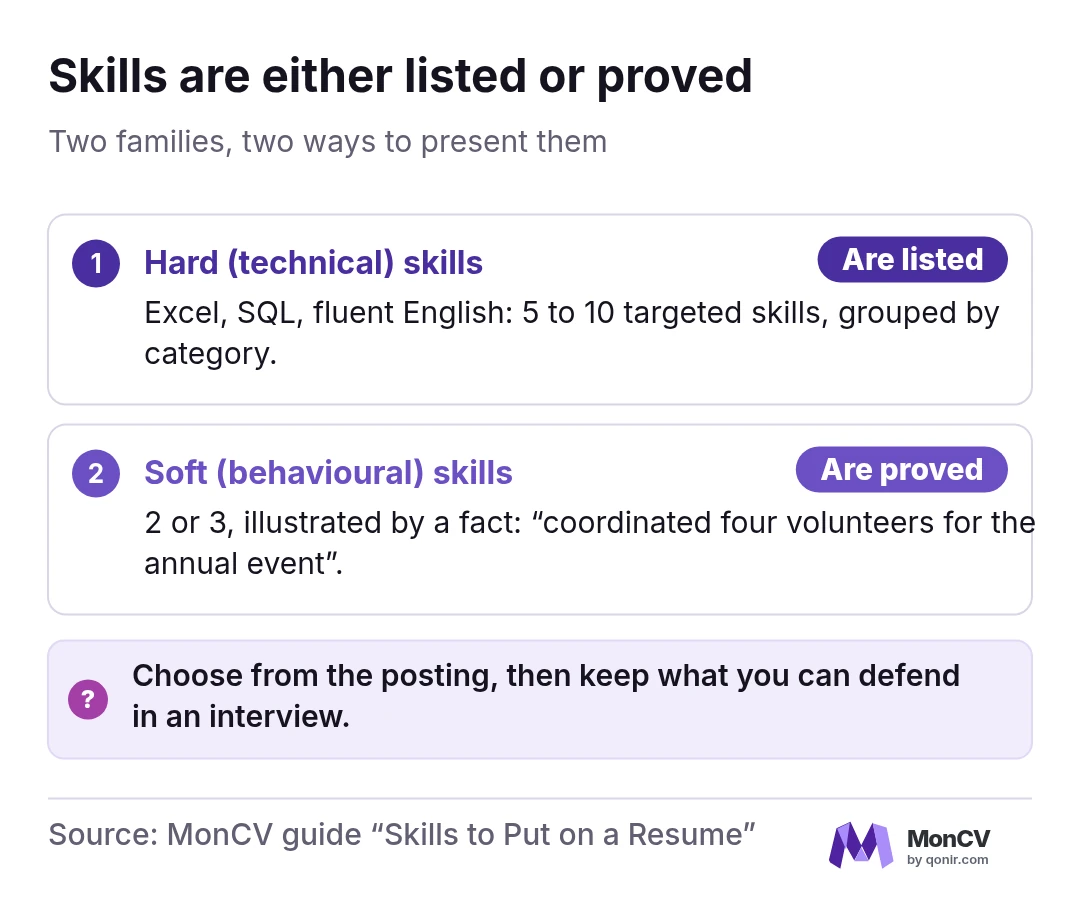
Hard (technical) skills: what you can verifiably do. A tool, a method, a language, a qualification, a licence: Excel, cash handling, SQL, drafting contracts, fluent English.
Soft (behavioural) skills: how you work with others and handle situations. Listening, organisation, independence, stress management.
The first kind is listed. The second kind is proved. Writing "team player" convinces nobody, because everybody writes it. Writing "coordinated a team of four volunteers for the society's annual event" shows the skill without naming it.
Start from the posting, not from your imagination
The most useful rule fits in one sentence: choose your skills from the posting, then keep the ones you can defend. Here is how.
1. Highlight the tools, methods and qualities that recur in the posting, especially those in the "requirements" section. 2. Compare with what you have really practised. For every word you keep, you must be able to give an example in an interview. 3. Reuse the posting's vocabulary when it is accurate: if it says "customer relations", do not write only "reception". This helps the human reader and an applicant tracking system alike (see our guide ATS-friendly resume). 4. Drop what is not requested or what you do not master. A word without proof is a risk, not an asset.
This is not about inventing. It is about choosing, from everything you can do, what answers this job.
How many skills should you list?
There is no official number. In practice, five to ten targeted hard skills, grouped by category, read better than a list of twenty items. For soft skills, two or three, backed by facts in your experience, are enough.
Add languages on a separate line, with the level in words ("English: fluent, used daily with customers") rather than with stars or bars. Bars are subjective: what does four out of five mean? They also cause reading problems for sorting software.
How to present them
A few formatting principles make the section readable in seconds:
Group by category: for example "Tools", "Methods", "Languages". Three well-labelled lines beat a word cloud.
Put the most important first, meaning those the posting asks for.
Write the exact name of tools: "Excel (pivot tables)" is more precise than "Office suite".
Avoid level bars, percentages and icons: they take space and teach nothing.
Place the section after experience if you have a solid background, before it if you are starting out or changing careers.
For layout, a customer service resume template puts the skills section in a clean column, with no level graphics.
Prove a skill without repeating it
The best proof lives in your experience. Take the key skills from the section and check that a line of experience illustrates them. A skill that appears in the list and in a result sentence becomes credible.
Take "prioritising". In the section: "Prioritising". In the experience: "Handled 40 customer requests a day by sorting urgent issues from simple ones". The second wording proves the first. (The figures in this example are fictional.)
For skills you do not yet have professional proof for, look elsewhere: school projects, volunteering, student societies, personal projects. Everything you have done counts, not only what was paid.
Fictional example: Sam's section, before and after
Sam is a fictional character, a customer adviser, applying to an e-commerce customer service posting. The posting asks for: customer relations by email and phone, a ticketing tool, complaint handling, fluent English, organisation.
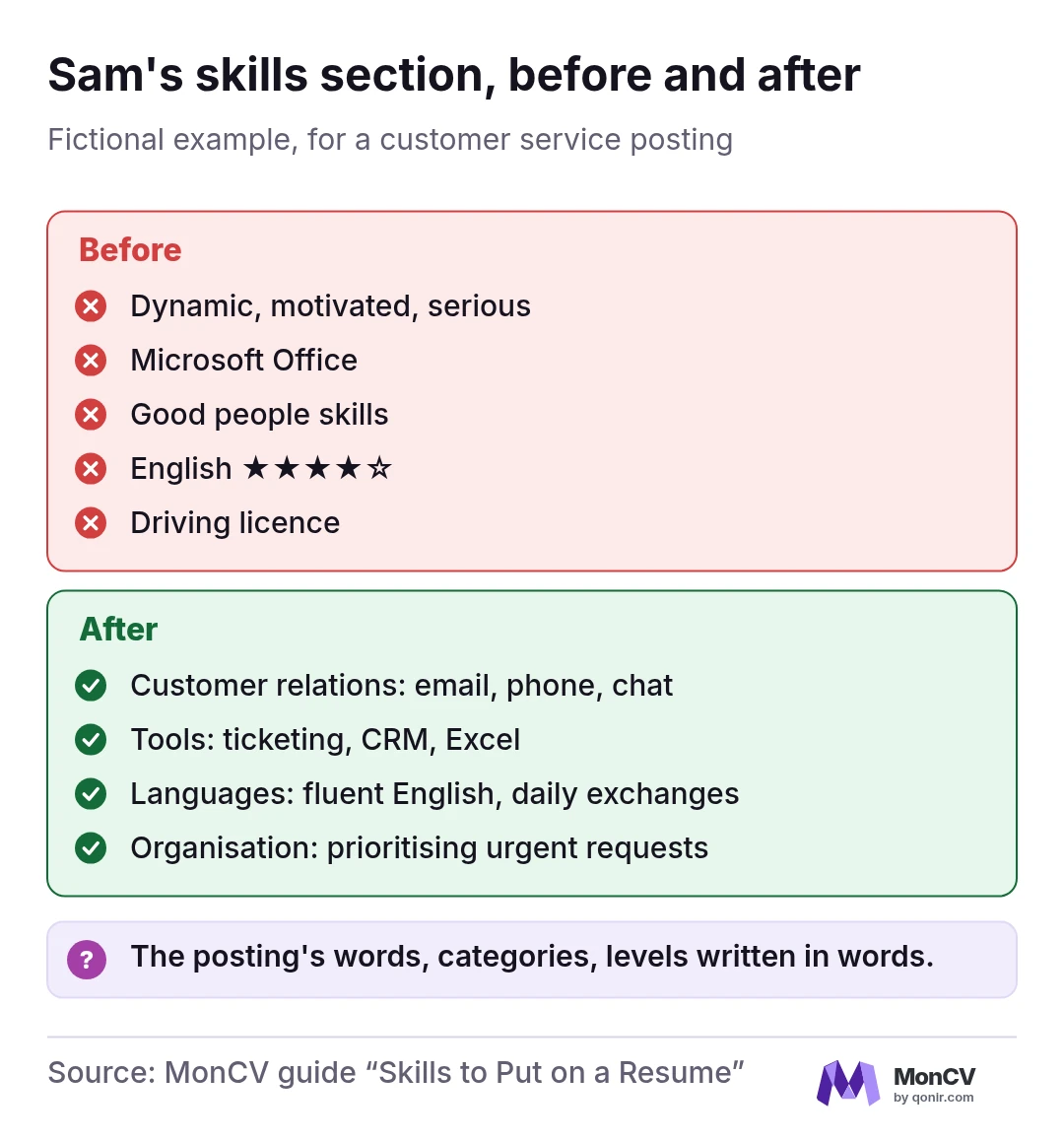
Before:
Dynamic, motivated, serious
Microsoft Office
Good people skills
English ★★★★☆
Driving licence
After:
Customer relations: email, phone, chat; complaint and refund handling
Tools: ticketing software, CRM, Excel (pivot tables)
Languages: French (native), fluent English (daily exchanges with customers)
Organisation: prioritising urgent requests, following cases through to closure
What changed: the generic qualities ("dynamic", "serious") are gone, replaced by skills that reuse the posting's wording. The English level is written in words. The driving licence was removed because the posting does not ask for it. And above all, each category is illustrated in a line of his experience, for example "Handled complaints by email and phone, from receipt to case closure".
The most frequent mistakes
Adjectives instead of skills: "dynamic", "hardworking", "motivated" cannot be verified.
Universal skills: "Microsoft Office" and "Internet" tell a recruiter nothing in 2026, unless the posting explicitly asks for them.
Very long lists: beyond about ten, the reader skips.
Exaggerated skills: writing "fluent English" and then stumbling in the interview costs more than writing "intermediate English".
Outdated skills: software you have not touched in ten years does not need to appear.
Adapt the section to each application
A skills section is not fixed. Keep a complete list for yourself, and for each application move the requested skills to the top and remove those with no link. It takes five minutes and changes the reading. You can create several versions of your resume from the resume builder or start from the resume templates, and complete them with a cover letter that develops one skill through a concrete example.
Key takeaways
A good skills section is short, targeted and verifiable. It reuses the posting's words for what you really can do, groups by category, describes levels in words and relies on proof in your experience. Adjectives and level bars can go without regret.
FAQ
How many skills should I put on a resume?
There is no official number. Five to ten targeted hard skills, grouped by category, read better than a long list. For soft skills, two or three backed by facts are enough.
Should I list soft skills on a resume?
Yes, but sparingly and with proof. List two or three and illustrate them in your experience rather than writing only "team player" or "rigorous".
Can I show levels with stars or bars?
It is not recommended: such bars are subjective and can hinder reading by some software. Describe the level in words, for example "fluent English, used daily".
What if I have no professional experience?
Draw on your studies, volunteering, student societies and personal projects. A skill proved by a project is worth more than a skill that is simply claimed.
Ready to present your experience clearly?
Build a clear, honest resume in a few minutes.