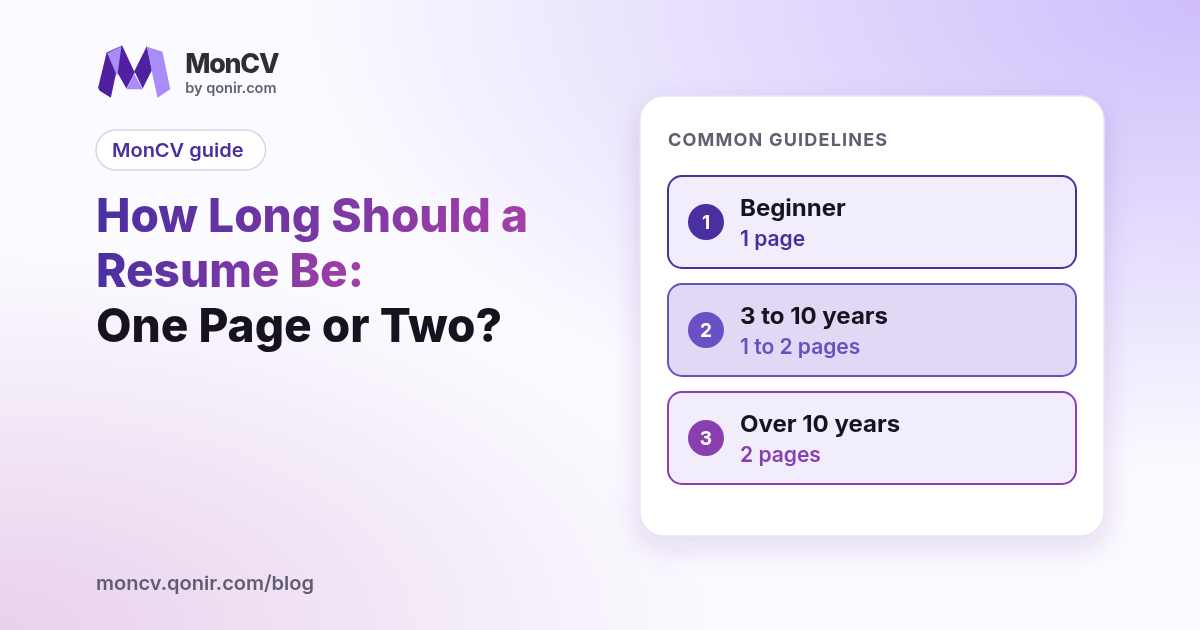
"My resume is a page and a half. Is that too long?" "I was told a good resume fits on one page." Both sentences come up constantly, and both contain some truth. There is no official rule for the number of pages in a resume. There are habits, and one simple test: readability. This guide gives you guidelines by situation, a method to cut without losing the essentials, and a fictional example explained page by page.
Why this question never goes away
A resume has one job: make someone want to read to the end, then meet you. A recruiter often goes through dozens of applications for the same role, and quickly looks for whether your background matches the posting. Every line that does not help answer that question dilutes the lines that do.
Length is therefore not a goal in itself. A one-page resume full of generalities is less useful than a two-page resume where every line brings proof. Conversely, a three-page resume that lists every task from the last twenty years tires the reader before page two.
One point often reassures people: applicant tracking systems (ATS) read a multi-page file without difficulty. Page count is not an automatic rejection criterion. The constraint comes from the human reader, not from the software. For the technical side, our guide ATS-friendly resume explains which format to prefer.
Guidelines by situation
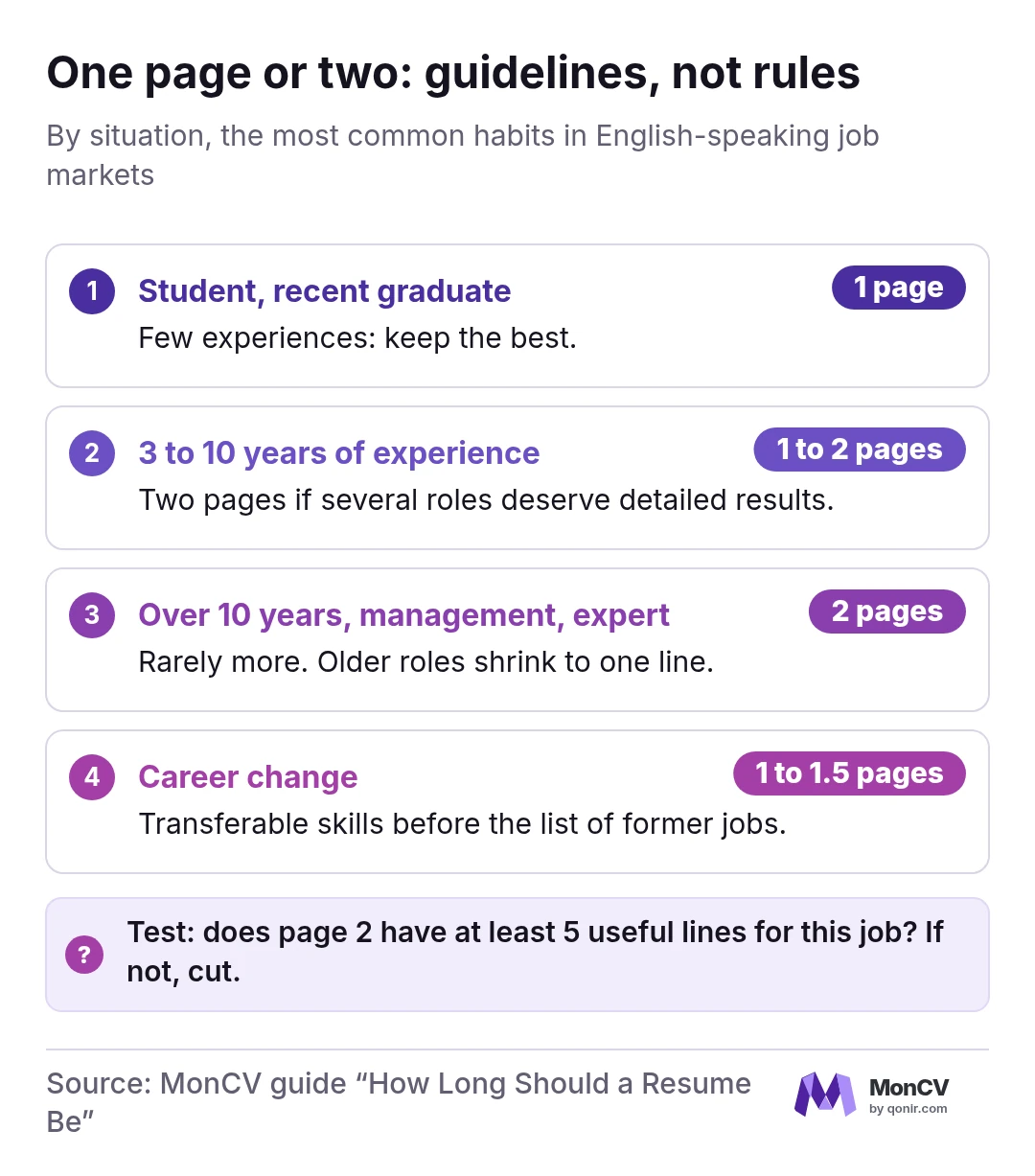
These are the most common habits in English-speaking job markets. They are guidelines, not rules: a good two-page resume beats a poor one-page resume.
Student, recent graduate, first job search: one page. You have few experiences, each deserves its place, and one page forces you to keep the best.
Three to ten years of experience: one page if it is enough, two pages if you have several roles that deserve detailed results. A page and a half is possible, but avoid leaving three stray lines at the top of page two.
More than ten years of experience, management or expert roles: two pages, rarely more. Older roles shrink to one line each.
Career change: one page or a page and a half, to put transferable skills ahead of the list of former jobs.
Academic or research profile: publications and teaching can justify a longer document, often presented in a different format from a standard resume, usually called a CV in that context.
If you hesitate between one and two pages, ask yourself: does the second page contain at least five lines that could make a difference for this specific job? If not, cut. If yes, keep it and fill it properly.
Mistakes that lengthen a resume without strengthening it
A few habits inflate a resume without making it stronger:
Duties written as tasks. "Responsible for managing social media" takes one line and says nothing. "Went from two to five posts a week, created a monthly newsletter" says what you did.
Old roles described as fully as recent ones. A job held twelve years ago does not need five lines.
Education and internships unrelated to the target role. A three-day work-experience placement at school can go.
Endless skill lists. Fifteen tools named, ten of them barely used, weaken the five you master.
Airy layouts or huge fonts. They push the resume to two pages without adding a single piece of information.
A four-step method to cut
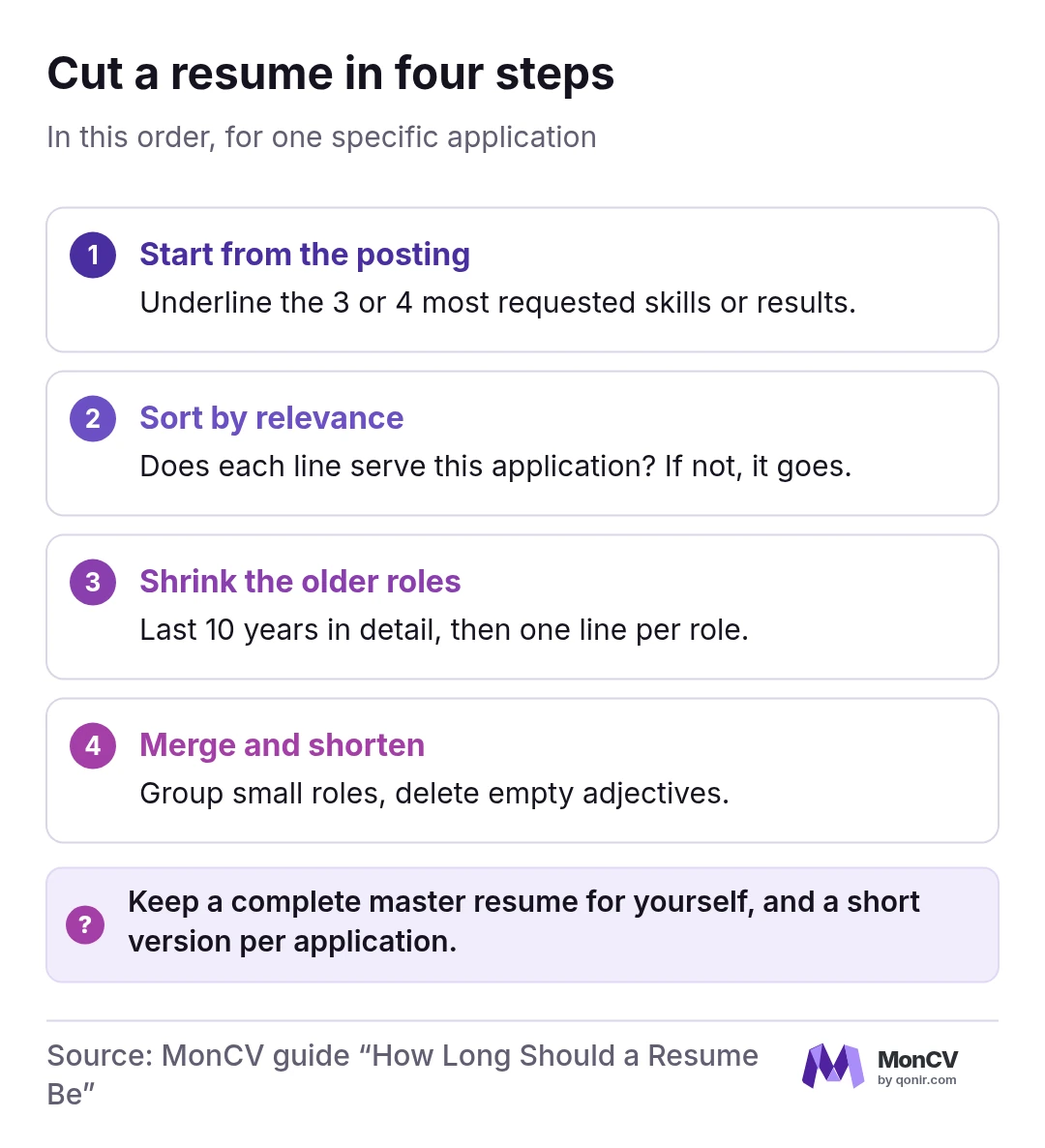
If your resume is longer than you want, work in this order.
1. Start from the posting. Underline the three or four most requested skills or results. These must be visible in the top half of page one. 2. Sort by relevance, not by date. For each line, ask whether it serves this application. A line useful for another type of job can leave this version: your resume is not an archive. 3. Shrink the older roles. Keep the last ten years or so in detail. Beyond that, one line per role: title, company, dates. 4. Merge and shorten. Group small, similar roles, delete empty adjectives ("dynamic", "motivated"), and replace sentences with short noun phrases.
Keep a complete master resume, long, for yourself. For each application, create a short adapted version. You save time and avoid cutting at random.
Fictional example: from three pages to two, page by page
Lea is a fictional character, a marketing officer with nine years of experience and four roles. Her first resume runs to three pages. Here is how she brings it down to two, for a digital marketing manager posting.
Page 1: what makes the difference.
At the top: name, target title, city, email, phone, link to a professional profile.
A three-line summary that echoes the two or three requirements of the posting.
The current role with five result bullets, each with a figure or a verifiable fact.
The previous role with three bullets.
Page 2: the complement.
The two older roles, with one or two bullets each.
Education, on two lines.
The skills useful for the posting, grouped in three categories, and languages.
What she removed: the detail of the first job (one line instead of eight), a degree-time internship, a list of eighteen software tools cut to six, and an "interests" section with no link to the role. The resume goes from three pages to two full pages, with no orphan paragraph.
Note what she did not do: shrink the font to 8 points or the margins to almost nothing. An unreadable resume is not shorter, only harder to read. For layout, a marketing resume template already spreads the sections over one or two pages with no effort.
Layout: fit the page without suffocating it
A few simple settings keep it readable:
Body text at 10 to 11 points, slightly larger for headings.
Margins of at least 2 cm (about 0.75 inch).
One main reading column, or two well-separated columns if the template is designed for it.
Short bullets, one idea per bullet, four to five bullets at most for a recent role.
Your name and contact details at the top of each page if the resume has two, which avoids loose sheets.
If your resume spills a few lines onto a second page, do not shrink everything. Cut those lines, or expand enough to justify the full page.
Digital versions and online applications
In most cases your resume is sent as a PDF or uploaded to a form. Length does not change how the file behaves, but it changes the reading on screen: on a phone, a very dense page is tiring to scroll. A short, airy resume with clear section headings reads better than two pages of tight text.
Also think about the file name: "Firstname-Lastname-Role-Resume.pdf" is more useful than "resume-final-v3.pdf" to the recruiter who saves it.
What about the cover letter?
A short resume pairs well with a letter that develops one example. If you had to cut an important achievement, it can find a place there in a few lines. Our cover letter page helps you write it, and you can build everything from the resume builder or start from the resume templates.
Key takeaways
There is no ideal number of pages, but there is a good reflex: one page for a short background, two pages for a long and dense one, three pages almost never. To decide, look at each line through the eyes of the recruiter reading the posting. If it helps them decide to call you, it stays. If not, it goes.
FAQ
Is a two-page resume frowned upon?
No, as long as the second page is useful. For a background of several years or a management role, two pages are common. The problem is a second page that is almost empty or filled with details unrelated to the posting.
Does the page count affect how an ATS reads my resume?
Generally no. An ATS reads a multi-page file without difficulty. What matters is that the text is real and selectable, with classic section headings.
What if my resume runs a few lines over one page?
Cut those lines rather than shrinking the font or margins. Remove older or unrelated experience first, then shorten the wording.
Can I have a one-page resume with ten years of experience?
Yes, if everything essential fits and stays readable. Many recruiters appreciate concision. Keep the detail for your most recent and most relevant roles.
Ready to present your experience clearly?
Build a clear, honest resume in a few minutes.