You are looking for your first job, an internship or an apprenticeship, and the posting asks for a cover letter. The problem is obvious: what do you write when you have no professional experience yet? The good news is that a recruiter reading a beginner's letter does not expect ten years of career. They want to see that you understood the role, that you have already done something comparable, even on a small scale, and that you can write it down clearly. This guide shows how to build that letter step by step, with a complete example you can adapt.
What a recruiter really expects from a letter with no experience
Facing an entry-level application, a recruiter asks three questions: does this person understand what we are looking for, have they already shown they can do concrete things, and are they serious about applying? They are not looking for perfection. They are looking for signals.
A letter with no experience rarely fails because of missing degrees. It fails because it is generic. "Motivated, dynamic and rigorous" proves nothing, and the same sentence could appear in any application. By contrast, a short letter that names a specific task, a number and a reason for applying to this particular company stands out immediately.
Keep one simple rule in mind: every sentence must answer "so what?". If you write that you enjoy working with people, add the moment you proved it. If you write that you are organised, give the example.
The four-paragraph structure
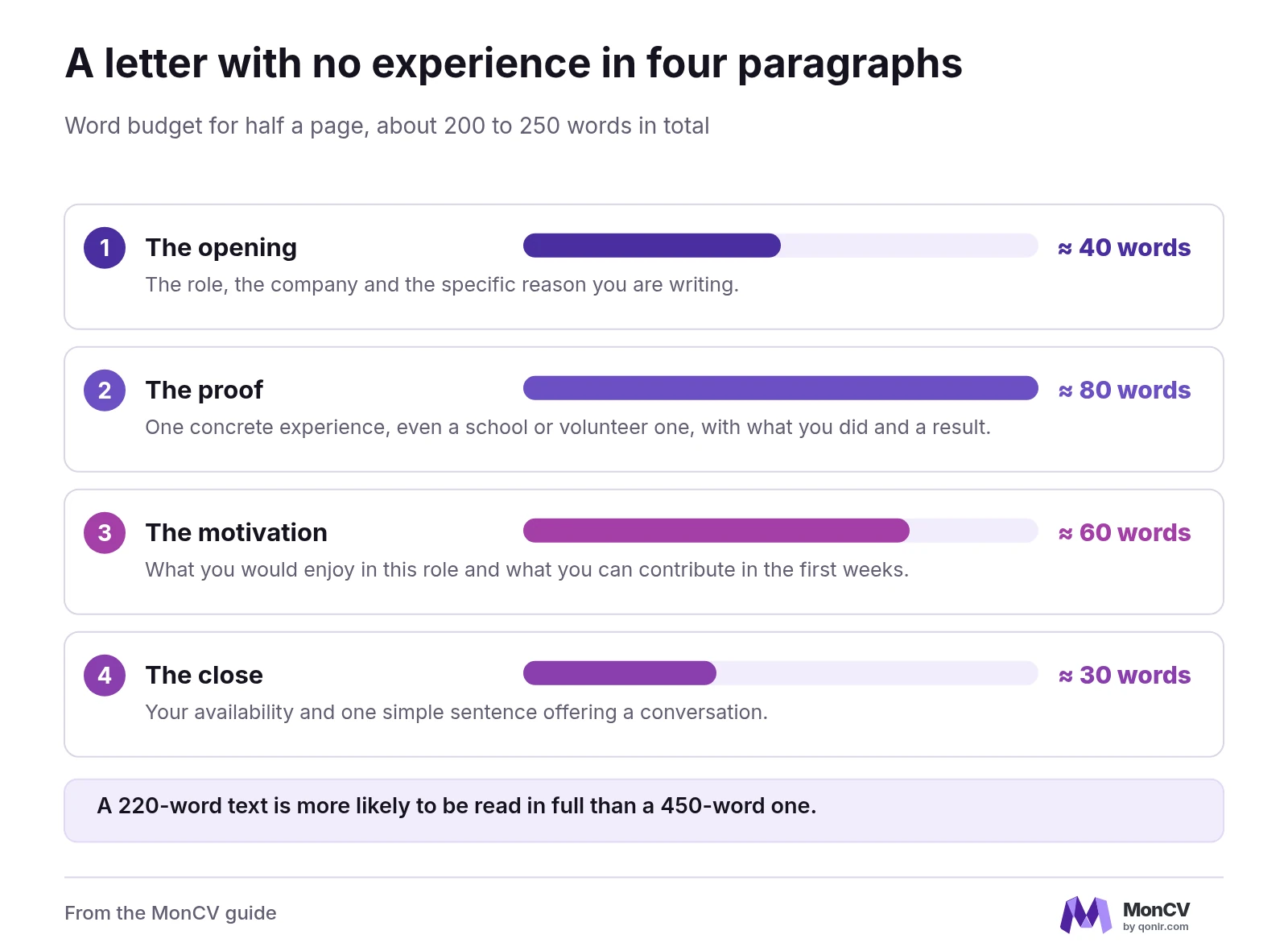
A beginner's letter fits on half a page, about 200 to 250 words. Four paragraphs are enough, each with a precise job.
The opening, about 40 words: the role, the company, and the specific reason you are writing.
The proof, about 80 words: one concrete experience, even a school or volunteer one, with what you did and a result.
The motivation, about 60 words: what you would enjoy in this role and what you can contribute in the first weeks.
The close, about 30 words: your availability and one simple sentence offering a conversation.
This outline is deliberately short. A recruiter sorting fifty applications reads most letters in under a minute. A 220-word text is therefore more likely to be read in full than a 450-word one.
Where to find material when you think you have nothing
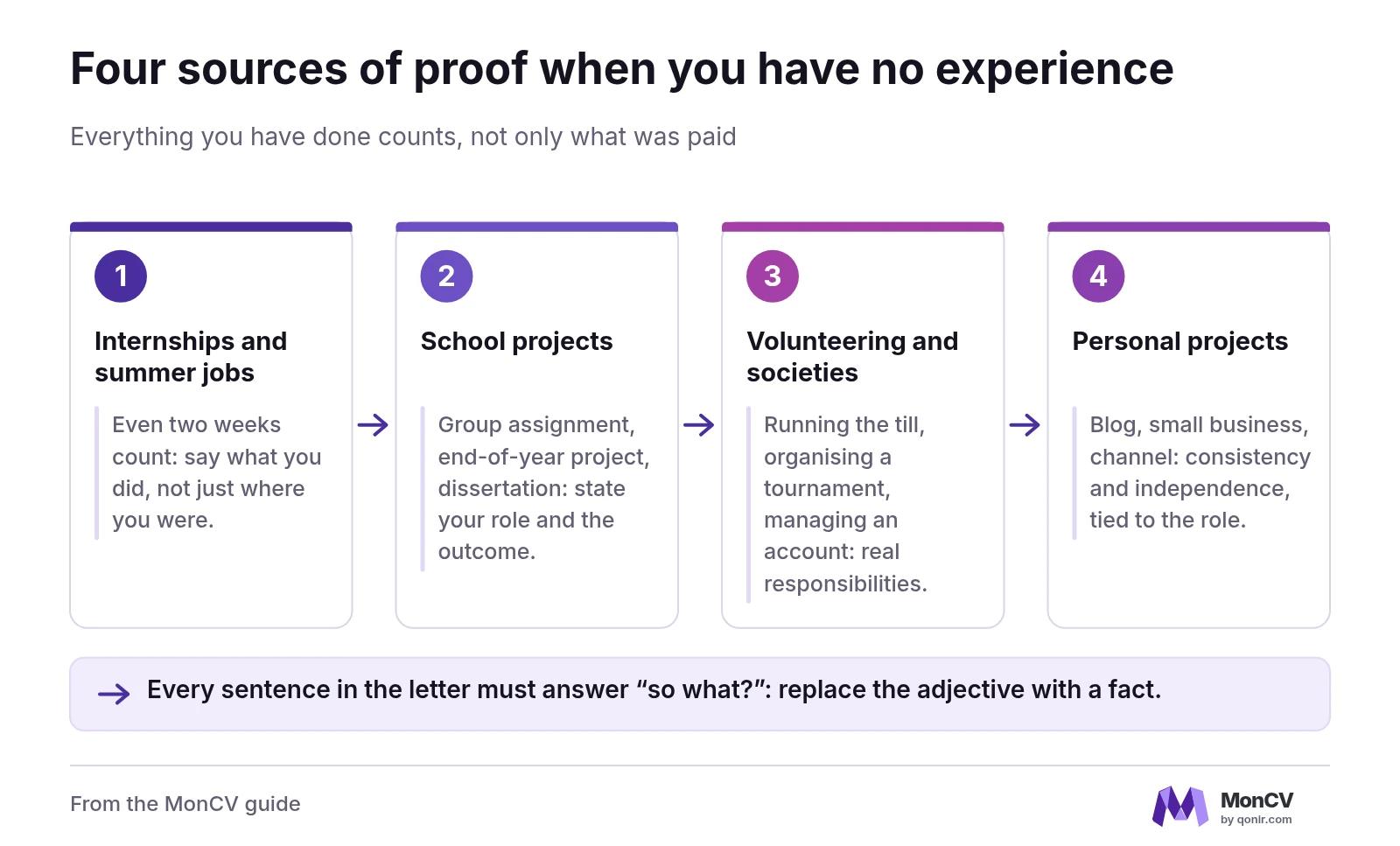
Almost everyone has more material than they think. The trap is to call "experience" only what was paid. Here are four sources that recruiters accept perfectly well for a first job.
Internships and summer jobs
Even two weeks of an observation placement count. Say what you did, not just where you were. "I filed client records and prepared meeting notes" is worth more than "observation placement in a company".
School projects
A group assignment, an end-of-year project or a dissertation shows that you can keep a deadline, work with others and deliver. State your role and the outcome: a grade, a presentation in front of a panel, a tool that was actually used.
Volunteering and student societies
Running the till for a society, organising a tournament, managing a social media account: these are real responsibilities. They are often read favourably for first jobs because they show initiative.
Personal projects
A blog, a small resale business, a channel that found its audience: anything that shows consistency and independence can find its place, as long as it stays connected to the role you are applying for.
Complete example: Ines applies for a bookshop assistant job
To make this concrete, take Ines, 21, a literature student, answering an ad for a bookshop assistant at an independent bookshop. She has never had an employment contract. Here is how she goes about it.
First, she lists what she has done. For two summers she helped in her parents' shop. She also ran her student society's library for a year, with about 300 books to lend and a tracking sheet for returns. And she runs an account recommending novels, followed by around a hundred people.
Next, she picks one strong proof for the central paragraph: the society library. She writes:
"For a year I ran my student society's library: about 300 books, a loan-tracking sheet and a reminder message for every late return. The share of books returned on time went from half to three quarters in one term. I enjoyed advising each reader according to their taste, and that is what I would like to do at your shop."
Notice what makes this paragraph work: a context (the society), a volume (300 books), an action (tracking and reminders), a result (from half to three quarters) and a link to the role (advising readers). It is about sixty words long and uses no filler adjective.
The opening picks up a detail about the bookshop: "Your children's literature section, which I have visited for years, made me want to apply as a bookshop assistant." That one sentence shows Ines knows the place. The close stays simple: available from 1 July, glad to come and talk.
Before and after: rewriting a weak sentence
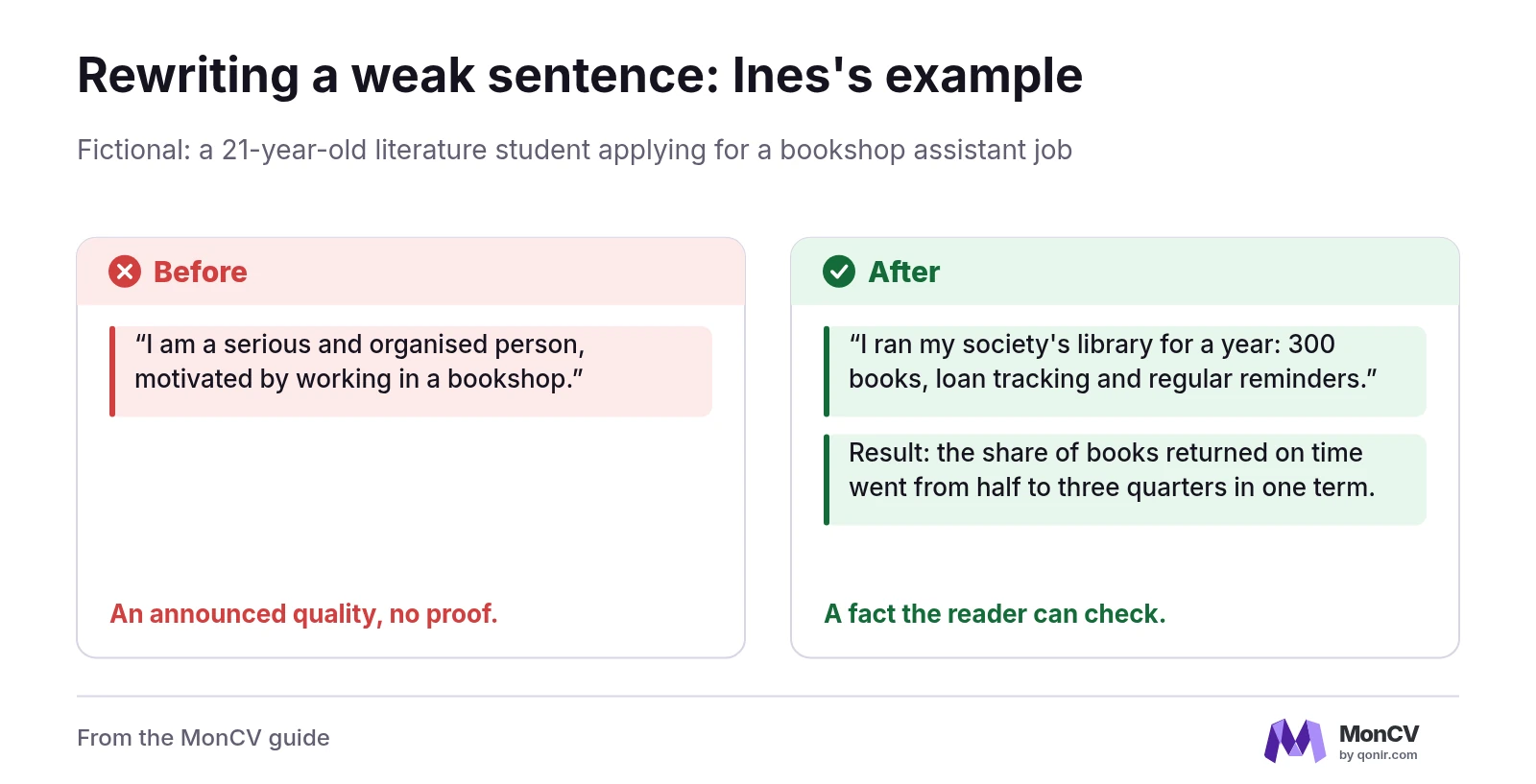
This is the most profitable change for a beginner: replace an announced quality with a fact.
Before: "I am a serious and organised person, motivated by working in a bookshop."
After: "I ran my society's library for a year: 300 books, loan tracking and regular reminders."
The second sentence does not say Ines is organised. It lets the reader see it. The reader draws the conclusion themselves, and believes it more.
Apply this test to every sentence of your letter. For each one, ask whether a reader could check it or picture it. If the answer is no, replace it with an example, or delete it.
How to talk about a lack of experience without apologising
Never start with "although I have no experience". That phrase puts the gap at the centre and invites the reader to look for it. It is better to present what you have done and let the resume show the rest.
If the lack of experience is obvious, one honest sentence is enough, placed at the end of the proof paragraph: "I am new to the trade, and I am ready to learn fast from your team." It acknowledges the situation without dwelling on it. Avoid vague promises such as "I will give 100%": they commit nobody and impress nobody.
If your background includes a break or a change of direction, that can be handled clearly too. Our guide on how to explain an employment gap on your resume gives wording that also works in a letter.
Adapting the letter to each posting
A letter sent unchanged to twenty companies is recognised immediately. To adapt quickly, reread the posting and spot two or three words that keep coming up: "customer advice", "autonomy", "shelf organisation". Reuse them in your proof paragraph, with your own examples, without copying the ad.
Also add one detail specific to the company: a product, a stated value, a recent event. One sentence is enough, but it must be true and specific. It takes five minutes and changes how your letter is perceived.
To save time on layout, you can prepare your text in MonCV's cover letter builder, then keep the same outline for every posting and change only the opening and the proof.
Consistency with your resume
The letter and the resume are read together. If the letter highlights the society library, the resume should show it in a clear section, with the same numbers. Do not repeat the resume word for word: the letter explains why this experience matters, the resume gives the facts and the dates.
For a first resume, layout matters too. Choose a clean, readable format, one page at most. You can create your resume online starting from one of the resume templates suited to beginners, where education and projects come before work experience.
The most common mistakes
A letter longer than one page: beyond that, most readers switch off.
The company or recruiter name forgotten or wrong after a copy and paste.
Whole sentences copied from templates found online: recruiters recognise them.
An opening that starts with "Currently a student in...": the information is already on the resume.
No read-aloud check: typos and overlong sentences show up when you hear them.
Checklist before you send
Before sending, reread your letter with these questions. Are the role and company named correctly? Does the proof contain an action and a result? Does the text fit in 250 words or fewer? Is every adjective backed by a fact? Are your contact details and availability included? If you answer yes to everything, the letter is ready.
A letter with no experience does not need to be brilliant. It needs to be precise, short and honest. That is what sets it apart from the pile, and it is well within reach from your very first application.
FAQ
How long should a cover letter with no experience be?
Aim for half a page, about 200 to 250 words in four paragraphs: opening, proof, motivation and close.
What do I put in the letter if I have never worked?
Lean on an internship, a school project, a volunteer activity or a personal project. Describe what you did and one concrete result.
Should I say that I have no experience?
Not in the opening. If it is obvious, one honest sentence at the end of the proof paragraph is enough, for example saying that you learn fast.
Can I use the same text for several postings?
Keep the same outline, but change the opening and the proof to reuse each posting's words and a detail specific to the company.
Ready to present your experience clearly?
Build a clear, honest resume in a few minutes.