Six months out of work, a year caring for a parent, a career change that took longer than planned: almost everyone has an empty stretch in their work history at some point. What worries people is less the gap itself than how a recruiter will read it. The good news is that an employment gap on a resume is easy to handle when it is presented clearly. This guide shows where to put it, how to word it, and how to talk about it in an interview, with a complete before and after example.
What a recruiter actually wonders about a gap
A recruiter who spots a break is not trying to judge your private life. They ask three simple questions. Is this person available now? Are their skills still current? Are they hiding something? If your resume answers those three questions before they are asked, the empty period stops being a warning sign.
The real problem is vagueness. Imprecise dates, a previous job stretched to cover the missing months, or a blank line with no explanation all create doubt. A short, honest mention does the opposite. It shows that you own your path and that you can get to the point.
Do you need to mention every break?
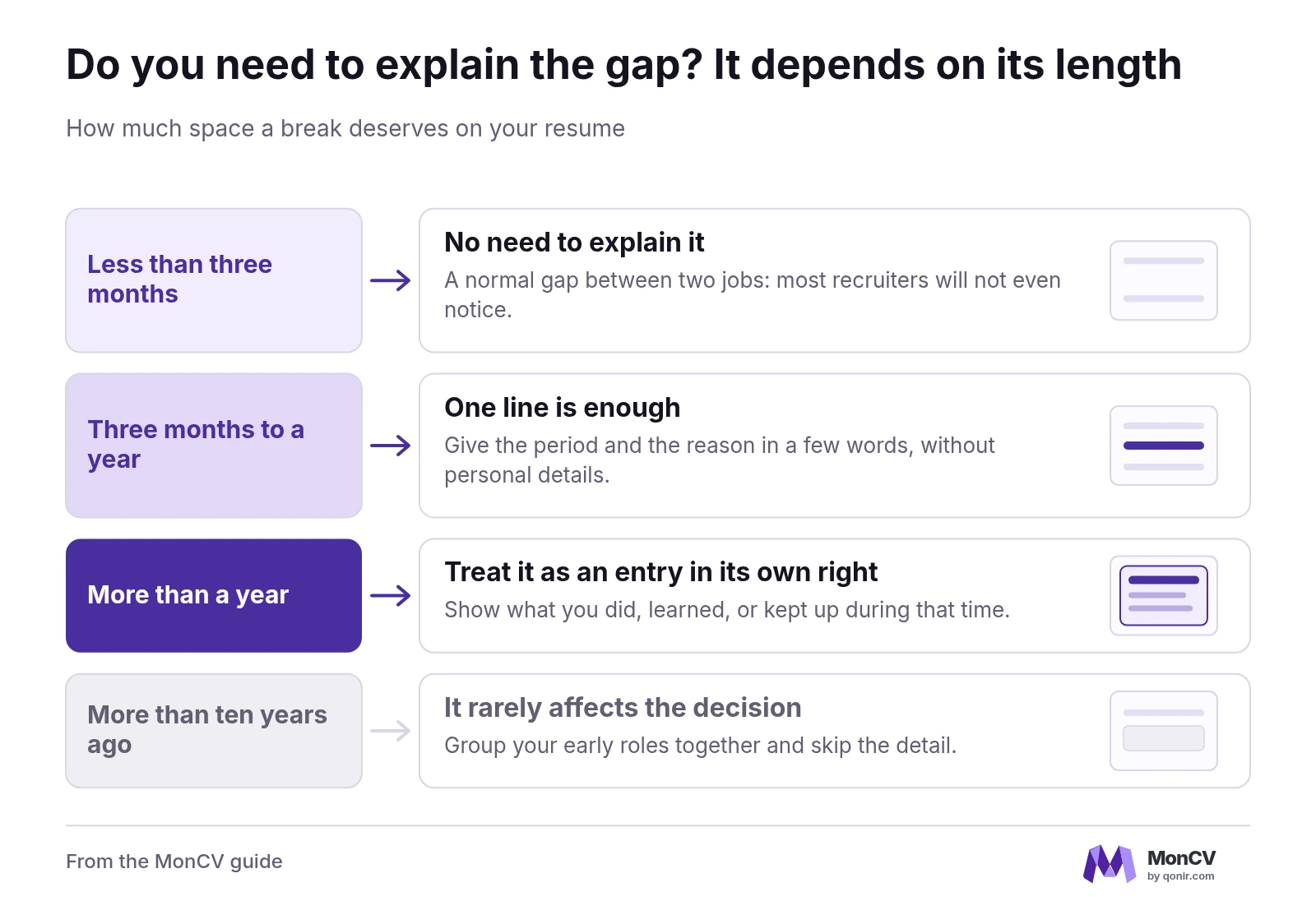
No. It depends on how long the break was and how long ago it happened.
Less than three months: no need to explain it. That is a normal gap between two jobs, and most recruiters will not even notice, especially if you show years rather than months for older roles.
Three months to a year: one line is enough. Give the period and the reason in a few words, without personal details.
More than a year: treat it as an entry in its own right. Show what you did, learned, or kept up during that time.
A break more than ten years ago: it rarely affects the decision. You can group your early roles together and skip the detail.
Three ways to show the gap on your resume
There is no single right method. Pick the one that matches your situation and the job you want.
A dated line in your experience
This is the simplest approach. You add an entry to your work history with dates and a neutral title: "Parental leave", "Career break for family reasons", "Job search and training". Underneath, one or two bullet points are enough if you have something useful to show. This line keeps your timeline continuous, which also helps with applicant tracking software.
Highlighting what you did
If you took a course, ran a personal project, volunteered, or did occasional freelance work, the period is no longer empty: it becomes experience. Name it after what you actually did, for example "Web development bootcamp, career change" or "Volunteer, food bank coordination". Describe it with concrete results, as you would for a paid role.
A skills-first resume
When there are several breaks, a resume that opens with your key skills and then lists your roles more briefly can be easier to read. Be careful, though: a resume with no dates at all looks suspicious. Keep a simple timeline at the bottom of the page. To choose a suitable layout, browse our [resume templates](https://moncv.qonir.com/en/resume-templates) and prefer a clean, single-column structure if your history is already busy.
Words to use and words to avoid
Wording matters as much as layout. Stay factual, brief, and focused on what comes next.
Say this
Use neutral titles: "career break", "parental leave", "personal project", "training period".
End with your availability when it helps: "available immediately".
Avoid
Give the reason in a few words only. You do not have to describe a health issue or a family situation. "Health reasons, now resolved" or "caring for a relative" is plenty.
Avoid apologies and long justifications. A whole paragraph about a break draws attention to it instead of closing the topic.
Avoid adjusted dates. A recruiter who finds out in an interview or a reference check that a role was stretched loses trust at once.
Worked example: Claire's resume, before and after
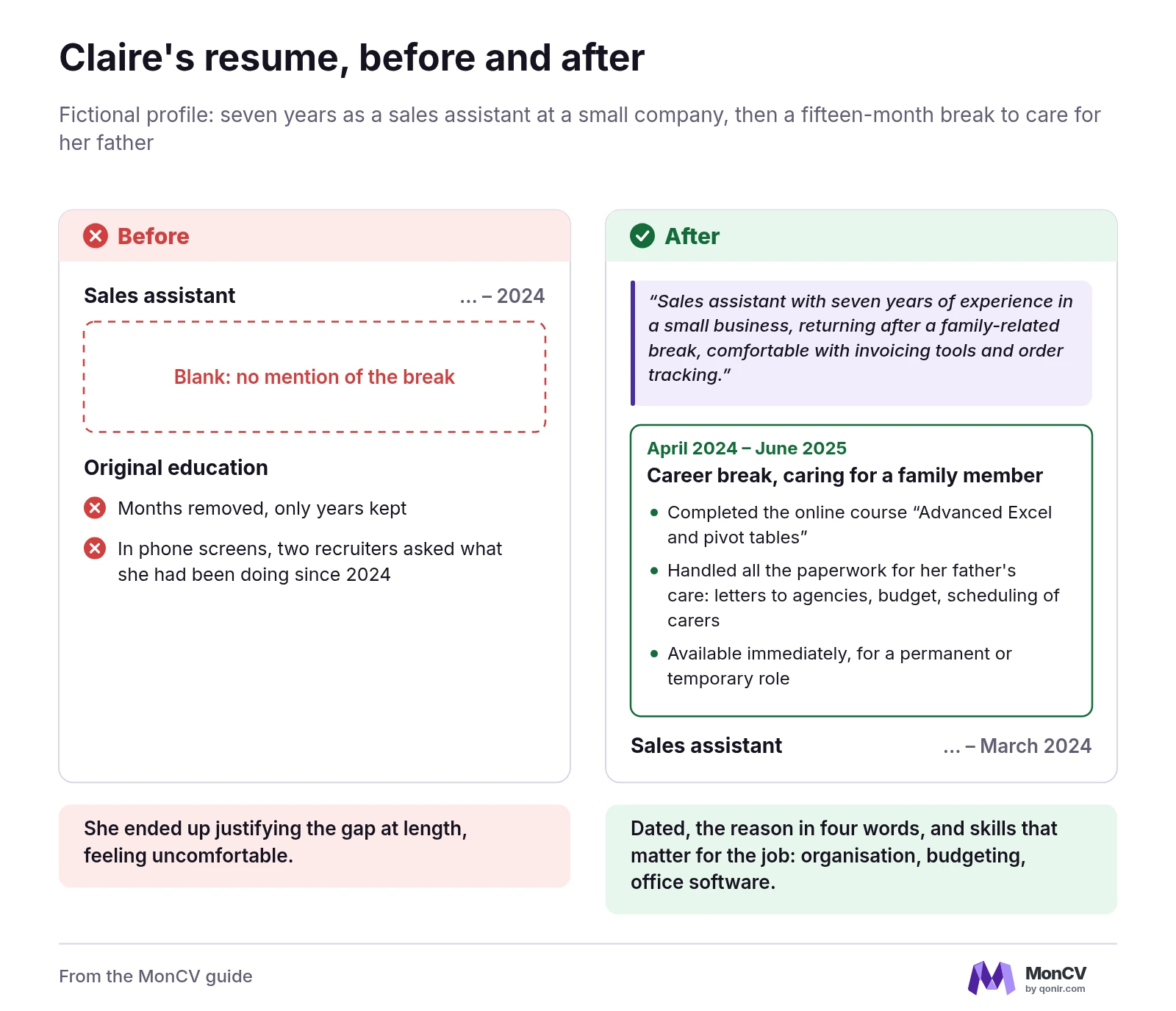
Claire is a fictional but representative profile. She worked as a sales assistant for seven years at a small distribution company. In 2024 she left her job to care for her father, who was ill. Fifteen months later, she wants to return to a sales assistant or administrative assistant role.
In her first version, Claire had simply left a blank. Her last job ended in March 2024, and the next line was her original education. She had also removed the months and kept only the years, hoping the gap would go unnoticed. The result: in phone screens, two recruiters asked what she had been doing since 2024, and she found herself justifying it at length, feeling uncomfortable.
In the new version, Claire adds an entry at the top of her experience:
April 2024 – June 2025: Career break, caring for a family member.
Completed the online course "Advanced Excel and pivot tables".
Handled all the paperwork for her father's care: letters to agencies, budget, scheduling of carers.
Available immediately, for a permanent or temporary role.
She also adds a summary line at the top of the resume: "Sales assistant with seven years of experience in a small business, returning after a family-related break, comfortable with invoicing tools and order tracking."
The difference is clear. The period is dated, the reason takes four words, and the bullet points show skills that matter for the job: organisation, budgeting, office software. The recruiter no longer needs to ask, because the answer is already there. Claire rebuilt her resume in one evening with our [resume builder](https://moncv.qonir.com/en/create-resume), starting from her previous version.
What about the cover letter?
A cover letter is not the place to tell the story of the break. If it is already explained on the resume, one sentence is enough, ideally in the last paragraph: "After a break to care for a family member, I am fully available and looking forward to bringing my experience to a sales team again." The rest of the letter should be about the job and what you bring to it. If you are starting from a blank page, our [cover letter](https://moncv.qonir.com/en/cover-letter) tool helps you structure that short message.
How to talk about it in an interview
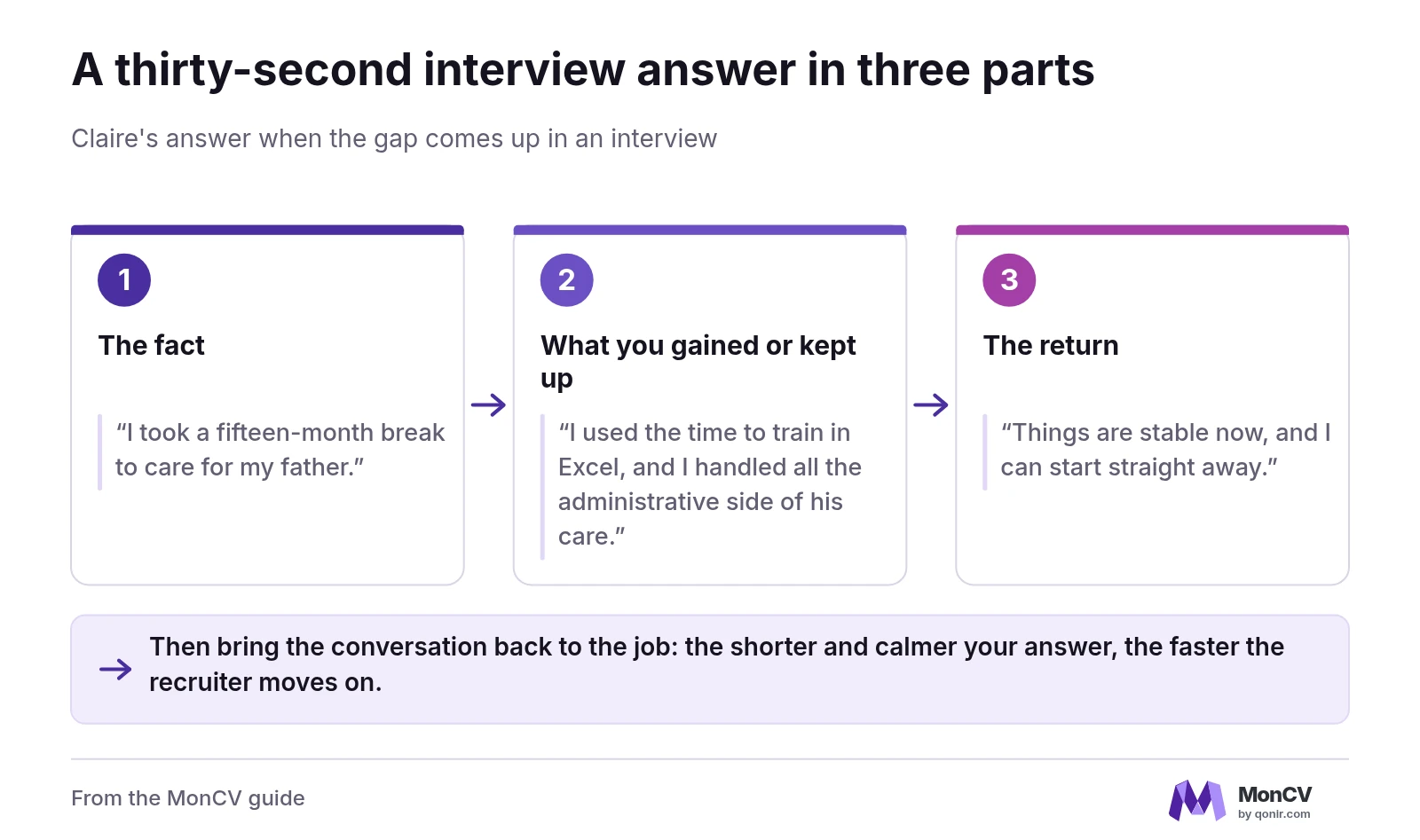
Even with a clear resume, the question may come up in person. Prepare a thirty-second answer in three parts.
The fact: "I took a fifteen-month break to care for my father."
What you gained or kept up: "I used the time to train in Excel, and I handled all the administrative side of his care."
The return: "Things are stable now, and I can start straight away."
Then bring the conversation back to the job. The shorter and calmer your answer, the faster the recruiter moves on. Practise it out loud two or three times: people tend to say too much when they are nervous.
The most common mistakes
Leaving a blank with no mention, hoping nobody notices.
Stretching the dates of a previous role to hide the gap.
Sharing personal details that tell the recruiter nothing useful.
Apologising, on paper or in person, as if the break were a fault.
Forgetting to refresh your skills: a short course, even a free one, shows you stayed active.
A gap in your resume is not a handicap in itself. The way you present it is what makes the difference. Date it, name it simply, show what you did during that time, and state your availability. The recruiter can then focus on what matters: your skills and what you can bring to the role.
FAQ
Should I explain a gap of less than three months?
No. A few weeks or two months between jobs is common. An explanation is only useful from around three months.
Do I have to give the exact reason for a break, such as a health issue?
No. A neutral phrase like "health reasons, now resolved" is enough. You do not have to share private details.
Can I hide a gap by removing dates from my resume?
It is not recommended. A resume with no dates looks suspicious to recruiters. Keep at least a simple timeline.
How do I talk about a resume gap in an interview?
Prepare a thirty-second answer: the fact, what you did or learned during that time, and your availability. Then bring the conversation back to the job.
Ready to present your experience clearly?
Build a clear, honest resume in a few minutes.